How to Learn Egyptian Arabic Online?
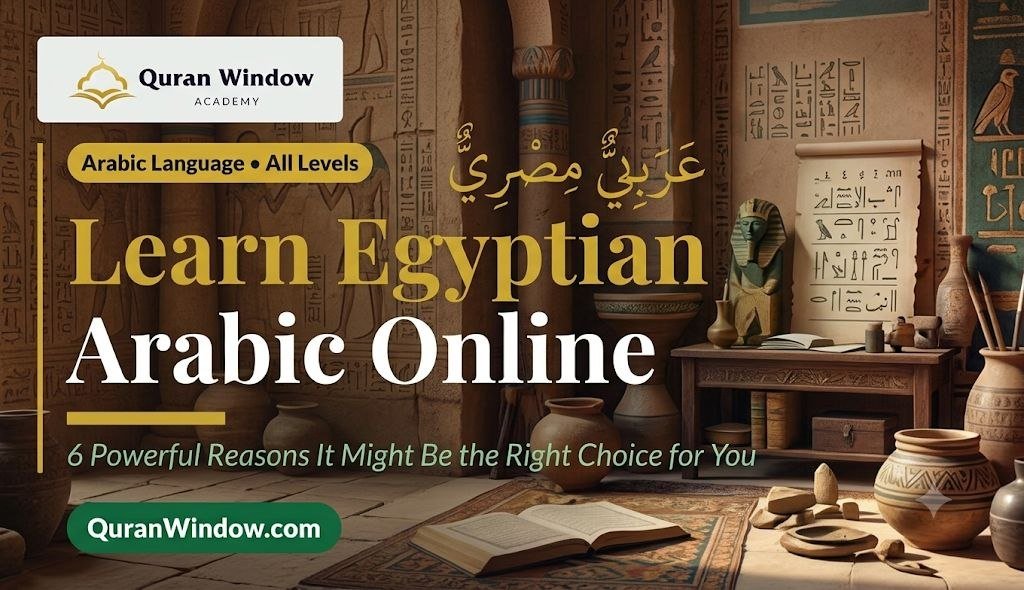
If you have spent any time researching how to learn Egyptian Arabic online, you have likely encountered a recurring question that creates genuine confusion: should you learn Egyptian Arabic, Modern Standard Arabic, or Quranic Arabic? Each path leads somewhere different — and choosing the wrong one for your specific goals means months or years of study that does not actually serve what you wanted to achieve.
This complete guide answers the question directly: is learning Egyptian Arabic online right for you? We explore the 6 powerful reasons someone might choose to Egyptian Arabic classes, who this path genuinely serves, how it compares to Quranic Arabic and Modern Standard Arabic, and — most importantly for Muslim learners — how Egyptian Arabic fits into a complete journey toward understanding the Quran. By the end, you will know with confidence whether learn Egyptian Arabic online is the right next step for your specific Arabic language goals.
What You Will Learn in This Guide
✓ What Egyptian Arabic is and how it differs from Quranic and Modern Standard Arabic
✓ 6 powerful reasons people choose to learn Egyptian Arabic online
✓ Who Egyptian Arabic genuinely serves — and who it does not
✓ How Egyptian Arabic relates to your Quran learning journey
✓ The best approach if your primary goal is Quran comprehension
✓ The complete Arabic learning pathway at Quran Window Academy
What Is Egyptian Arabic? Understanding the Dialect Before You Learn It
Before deciding whether to learn Egyptian Arabic online, it is essential to understand precisely what Egyptian Arabic is — and how it relates to the other forms of Arabic you may have heard about.
Egyptian Arabic — The Most Widely Understood Spoken Dialect
Egyptian Arabic (Masri) is the colloquial, spoken dialect of Arabic used in everyday conversation throughout Egypt — by over 100 million native speakers, and understood by hundreds of millions more across the Arab world due to the historical dominance of Egyptian cinema, television, and music. Unlike Quranic Arabic or Modern Standard Arabic, Egyptian Arabic is not typically written in formal contexts — it is the spoken language of daily life: markets, homes, streets, and informal conversation.
For someone who wants to learn Egyptian Arabic online, the appeal is clear: Egyptian Arabic is the most widely understood Arabic dialect across the entire Arab world — a result of decades of Egyptian media dominance. An Egyptian Arabic speaker can be understood, to varying degrees, from Morocco to Iraq — a unique advantage that no other regional dialect offers.
How Egyptian Arabic Differs from Quranic Arabic
The most important distinction for anyone considering whether to learn Egyptian Arabic online is understanding its relationship to Quranic Arabic (Classical Arabic) — the Arabic of the Quran. Egyptian Arabic and Quranic Arabic share the same alphabet and many root words, but differ significantly in grammar, vocabulary, pronunciation, and sentence structure. A person who has learned only Egyptian Arabic will find significant portions of the Quran’s vocabulary and grammar unfamiliar — because Egyptian Arabic has evolved away from Classical Arabic over centuries of natural linguistic change.
📖 Quranic Arabic vs Modern Arabic: 7 Powerful Differences Every Muslim Must Know
6 Powerful Reasons to Learn Egyptian Arabic Online
Here are the 6 powerful reasons why someone might genuinely benefit from choosing to learn Egyptian Arabic online — and the specific circumstances where each reason applies:
Reason 1: You Plan to Travel to or Live in Egypt
The most direct reason to learn Egyptian Arabic online is practical necessity: you are planning to travel to Egypt, relocate there for work or study, or have family connections requiring regular communication in the dialect. For this purpose, Egyptian Arabic is unambiguously the correct choice — no other form of Arabic will serve daily communication in Cairo, Alexandria, or any Egyptian city as effectively.
Reason 2: You Want to Understand Egyptian Media, Film, and Music
Egypt has historically been the centre of Arabic-language film, television, and music production — meaning Egyptian Arabic is the dialect of the region’s most influential cultural exports. For learners motivated by access to Egyptian cinema’s golden age, contemporary Egyptian television dramas, or Egyptian music, learning Egyptian Arabic online provides direct access to this rich cultural heritage in its original form.
Reason 3: You Want the Most Widely Understood Spoken Dialect
For learners whose goal is broad conversational ability across the Arab world — not specific to any one country — Egyptian Arabic’s unique status as the most widely understood (though not necessarily spoken) dialect across the region makes it a practical choice. Someone who wants to learn Egyptian Arabic online for general Arab-world communication is choosing the dialect most likely to be understood by the broadest range of native Arabic speakers, regardless of their own country’s specific dialect.
Reason 4: You Have Egyptian Family or Community Connections
Many learners pursuing Egyptian Arabic online are doing so to communicate more effectively with Egyptian family members, in-laws, or community members — particularly in the Egyptian diaspora communities across the UK, USA, Canada, and Australia. For these learners, Egyptian Arabic is not an abstract academic choice but a practical tool for strengthening specific family and community relationships.
Reason 5: You Want a More Accessible Entry Point to Spoken Arabic
Some learners find that beginning with a colloquial dialect like Egyptian Arabic — rather than Classical or Modern Standard Arabic — provides a more immediately rewarding and conversationally functional starting point. The simplified grammar of spoken Egyptian Arabic (compared to the more complex case system of Classical Arabic) can feel more achievable for absolute beginners focused purely on conversational ability rather than reading classical texts.
Reason 6: You Already Know Quranic Arabic and Want Conversational Range
For Muslims who have already invested significant time in Quranic Arabic — understanding the Quran’s vocabulary and grammar — adding Egyptian Arabic as a second step provides practical conversational ability that Quranic Arabic alone does not offer. This sequence — Quranic Arabic first, Egyptian Arabic as a conversational extension — allows learners to combine deep textual understanding of the Quran with practical, everyday communication ability across the Arab world.
Egyptian Arabic and Quranic Arabic serve different purposes. The question is not which is ‘better’ — it is which serves your actual goal. For Quran comprehension, Quranic Arabic comes first.
Is Learning Egyptian Arabic Online Right for You? A Clear Decision Framework
With the 6 reasons established, here is a clear framework for deciding whether to learn Egyptian Arabic online right now, or whether a different form of Arabic should be your priority:
Choose to Learn Egyptian Arabic Online If Your Primary Goal Is Conversation
If your primary motivation is spoken conversational ability — communicating with Egyptian friends, family, or contacts, traveling to Egypt, or accessing Egyptian media — learning Egyptian Arabic online is the direct, appropriate path. There is no reason to delay this goal by first studying Classical or Modern Standard Arabic if conversational Egyptian Arabic is genuinely your objective.
Choose Quranic Arabic First If Your Primary Goal Is the Quran
If your primary motivation is understanding the Quran — reciting with comprehension, following Tafsir, connecting more deeply with your daily prayers — Quranic Arabic should be your starting point, not Egyptian Arabic. The vocabulary, grammar, and sentence structures of Egyptian Arabic differ substantially enough from Quranic Arabic that someone who learns Egyptian Arabic first will still need to separately study Quranic Arabic to achieve genuine Quran comprehension. Starting with Quranic Arabic produces direct progress toward Quran understanding from the very first lesson.
Consider Both — In the Right Sequence
Many Muslim learners ultimately benefit from both forms of Arabic — but the sequence matters significantly. The most efficient path for most Muslim learners is: Quranic Arabic first (typically 1–2 years of focused study, providing access to 70%+ of Quranic vocabulary and the grammatical foundation that underlies all forms of Arabic), followed by Egyptian Arabic or Modern Standard Arabic as a practical conversational extension once the Quranic foundation is solid. This sequence ensures the spiritually primary goal — Quran comprehension — is never delayed or compromised by an initial focus on conversational dialect.
📖 Learn Arabic for Quran Recitation: The Ultimate 8-Step Guide
How to Learn Egyptian Arabic Online Effectively — If It’s Right for You
If, after this evaluation, you have determined that learning Egyptian Arabic online genuinely serves your goals — here is how to approach it effectively:
Start with High-Frequency Conversational Phrases
Effective approaches to learn Egyptian Arabic online begin with the most commonly used conversational phrases and vocabulary — greetings, everyday questions, common verbs, and the specific Egyptian Arabic expressions that differ most noticeably from Modern Standard Arabic (such as the characteristic Egyptian pronunciation of ج as a hard “g” sound, unlike most other Arabic dialects).
Focus on Listening Comprehension Early
Because Egyptian Arabic is fundamentally a spoken dialect with limited formal written tradition, effective learners who want to learn Egyptian Arabic online prioritize listening comprehension from the earliest stages — through Egyptian films, music, podcasts, and conversational practice — rather than relying primarily on written textbook study, which is the more natural approach for Classical or Modern Standard Arabic.
Work with a Native Egyptian Arabic Speaker
The dialectal nuances, idiomatic expressions, and natural rhythm of Egyptian Arabic are most effectively learned through direct interaction with native speakers — whether through structured online lessons, language exchange, or immersive conversational practice. A learner who studies Egyptian Arabic exclusively through written materials without native speaker interaction will struggle significantly with genuine conversational fluency.
Egyptian Arabic and Your Quran Learning Journey — How They Connect
For Muslim learners specifically, understanding how Egyptian Arabic relates to the broader Quran learning journey is essential context that most generic Arabic-learning resources do not address.
Egyptian Arabic Does Not Replace Quranic Arabic Study
It is important to be direct about this: learning Egyptian Arabic online — however successfully — does not substitute for dedicated Quranic Arabic study if your goal includes Quran comprehension. The grammar, vocabulary, and formal register of the Quran require specific study that conversational Egyptian Arabic, by its nature as an informal spoken dialect, does not provide. Many learners are surprised to discover that strong Egyptian Arabic conversational ability does not translate into strong Quranic comprehension — the gap between the two forms of Arabic is real and requires separate, dedicated attention.
Egyptian Arabic Can Enrich Your Quran Learning Journey as a Secondary Skill
That said, Egyptian Arabic — once Quranic Arabic foundations are solid — provides genuine value as a secondary skill: the ability to discuss Islamic topics conversationally with Arabic-speaking scholars and friends, to engage more deeply with Egypt’s rich tradition of Islamic scholarship (including Al-Azhar University itself, located in Cairo), and to navigate daily life if you travel to Egypt for study, Hajj/Umrah connections, or family visits. Many of our Al-Azhar certified teachers at Quran Window Academy are themselves native Egyptian Arabic speakers — bringing this dialectal fluency alongside their formal Quranic Arabic certification.
The Recommended Sequence for Muslim Learners
For Muslim learners specifically considering whether to learn Egyptian Arabic online, our recommendation based on years of teaching experience is clear: establish your Quranic Arabic foundation first. Once you can understand the majority of common Quranic vocabulary and have a working grasp of Classical Arabic grammar — typically achievable within 12–18 months of consistent study — Egyptian Arabic becomes an excellent and relatively quick addition, since many of the underlying grammatical concepts and vocabulary roots will already be familiar from your Quranic Arabic study.
Build Your Arabic Foundation the Right Way at Quran Window Academy
Whether your ultimate goal includes Egyptian Arabic conversational ability, deep Quranic comprehension, or both, Quran Window Academy provides the structured, certified Arabic learning pathway that builds your foundation correctly — starting with what matters most for your specific goals.
🟡 START HERE FOR THE QURAN — Arabic Language Course — Quranic Arabic Foundation
✓ Quranic Arabic vocabulary and grammar — the essential foundation for Quran comprehension
✓ 300 high-frequency Quranic words covering 70% of the Quran’s text
✓ Arabic root system — unlock multiple Quranic words from every root learned
✓ One-on-one sessions with a certified Al-Azhar Arabic teacher, many of them native Egyptian speakers
✓ Free trial class — experience the quality before any commitment
🔗 Arabic Language Course — Quranic Arabic
🟢 FOUNDATION FIRST — Quran Recitation Course
✓ Learn to read the Quran correctly with proper Tajweed — the essential first step
✓ Complete Noorani Qaida curriculum with a certified Al-Azhar teacher
✓ One-on-one sessions — every error corrected in real time
✓ Free trial class — no Arabic knowledge required to begin
🔵 DEEPEN MEMORIZATION — Quran Memorization Course
✓ Memorize with understanding — Arabic vocabulary study integrated with Hifz
✓ Certified Al-Azhar Hafiz teachers — correct Tajweed in every session
✓ Structured daily memorization and revision plan
🟠 DEEPEN UNDERSTANDING — Islamic Studies Course
✓ Tafsir study — understand the meaning and context of Quranic verses
✓ Connects directly to your Arabic language learning journey
✓ Taught in English with Arabic references — accessible for all levels
🎓 Book Your Free Trial Class Now
One-on-one live lesson with a certified Al-Azhar Arabic teacher.
Your first lesson is completely free — no commitment, no payment.
Available for: Kids • Adults • Beginners • Sisters (Female Teachers)
Frequently Asked Questions: Learn Egyptian Arabic Online
FAQ 1: Is Egyptian Arabic the same as the Arabic in the Quran?
No — Egyptian Arabic and Quranic Arabic are distinctly different forms of the language. Quranic Arabic is Classical Arabic, the formal foundation preserved unchanged in the Quran. Egyptian Arabic is a colloquial spoken dialect that has evolved significantly from Classical Arabic over centuries. Someone who wants to learn Egyptian Arabic online for conversational purposes will need separate, dedicated study to also achieve Quran comprehension.
FAQ 2: Should I learn Egyptian Arabic or Quranic Arabic first?
This depends entirely on your goal. If your primary motivation is understanding and reciting the Quran with comprehension, Quranic Arabic should come first. If your primary motivation is conversational ability with Egyptian speakers or travel to Egypt, learning Egyptian Arabic online directly serves that goal without requiring Quranic Arabic first.
FAQ 3: Can I learn Egyptian Arabic online effectively, or do I need to be in Egypt?
Yes — Egyptian Arabic can be learned very effectively online, particularly through one-on-one sessions with native Egyptian Arabic speaking teachers who provide the listening practice, conversational interaction, and immediate correction that dialect learning requires. Being physically in Egypt offers immersive advantages but is not necessary for developing strong conversational Egyptian Arabic ability.
FAQ 4: How long does it take to learn Egyptian Arabic online?
Basic conversational ability in Egyptian Arabic can typically be achieved within 4–8 months of consistent study with regular speaking practice. Fluent, natural conversational ability typically requires 1–2 years of consistent engagement. Learners who already have a foundation in Classical or Modern Standard Arabic often progress significantly faster, since substantial vocabulary and grammatical overlap exists.
FAQ 5: Is Egyptian Arabic harder or easier than Quranic Arabic to learn?
For purely conversational purposes, Egyptian Arabic is often considered more accessible for beginners because its grammar is simplified compared to the full case system of Classical Arabic. However, for reading and understanding formal or religious texts — including the Quran — Quranic Arabic provides the necessary foundation that Egyptian Arabic, as a primarily spoken dialect, does not.
FAQ 6: Will learning Egyptian Arabic help me understand other Arabic dialects?
Egyptian Arabic provides a useful starting point for understanding other dialects due to its widespread recognition across the Arab world from historical media dominance — but each regional dialect (Levantine, Gulf, Maghrebi) has significant differences. Egyptian Arabic offers the broadest passive comprehension advantage of any single dialect, though active fluency in other dialects would still require dedicated separate study.
FAQ 7: Do Quran Window Academy teachers speak Egyptian Arabic?
Yes — many of our certified Al-Azhar Arabic teachers are native Egyptian Arabic speakers, since Al-Azhar University itself is located in Cairo, Egypt. While our primary Arabic Language Course focuses on Quranic Arabic — the foundation most valuable for Muslim learners — our teachers’ native Egyptian Arabic fluency means they can also provide insight and conversational guidance for students interested in learning Egyptian Arabic as a secondary skill.
FAQ 8: Can children learn Egyptian Arabic online?
Yes — children can learn Egyptian Arabic effectively online, particularly through engaging, conversational, one-on-one lessons with native speakers. However, for Muslim families, we generally recommend establishing the child’s Quranic Arabic and Quran recitation foundation first, given its primary religious importance, before introducing Egyptian Arabic as a secondary conversational skill.
📖 Arabic Letters for Kids: The Ultimate 5-Step Method to Teach Them Correctly at Home
FAQ 9: What is the difference between Egyptian Arabic and Modern Standard Arabic?
Modern Standard Arabic (MSA) is the formal written and broadcast Arabic used across the Arab world for news, official documents, and education — closely related to Classical Arabic. Egyptian Arabic is the informal spoken dialect used in everyday Egyptian conversation, distinct from MSA in grammar, vocabulary, and pronunciation. Someone learning to read Arabic newspapers needs MSA; someone wanting to chat with Egyptian friends needs Egyptian Arabic.
FAQ 10: How do I start learning Arabic at Quran Window Academy?
Book your free trial class. The trial is 30 minutes, completely free, and your certified Al-Azhar Arabic teacher will discuss your specific goals — whether Quranic comprehension, conversational ability, or both — and recommend the right starting point and learning sequence for your situation. No payment, no commitment — just clarity on your best path forward.
Learn Egyptian Arabic Online — With the Right Foundation First
Deciding whether to learn Egyptian Arabic online comes down to a single clarifying question: what is your actual goal? If it is conversation, travel, or connection with Egyptian family and friends, learn Egyptian Arabic online is a direct and rewarding path — and one made even more effective through one-on-one lessons with native speakers. If your goal includes understanding and reciting the Quran, the wiser sequence is to establish your Quranic Arabic foundation first, then add Egyptian Arabic as a valuable conversational extension once that foundation is solid.
At Quran Window Academy, our certified Al-Azhar teachers — many of them native Egyptian Arabic speakers — are ready to guide you through whichever path genuinely serves your goals, in the sequence that makes the most sense for your situation. Your first lesson is completely free. Begin with clarity, and build your Arabic journey on the right foundation.
Egyptian Arabic opens conversations. Quranic Arabic opens the Quran. Know which door you are trying to open — and build your foundation accordingly.
🎓 Book Your Free Trial Class Now
One-on-one live lesson with a certified Al-Azhar Arabic teacher.
Your first lesson is completely free — no commitment, no payment.
Available for: Kids • Adults • Beginners • Sisters (Female Teachers)