Surah Al-Kahf
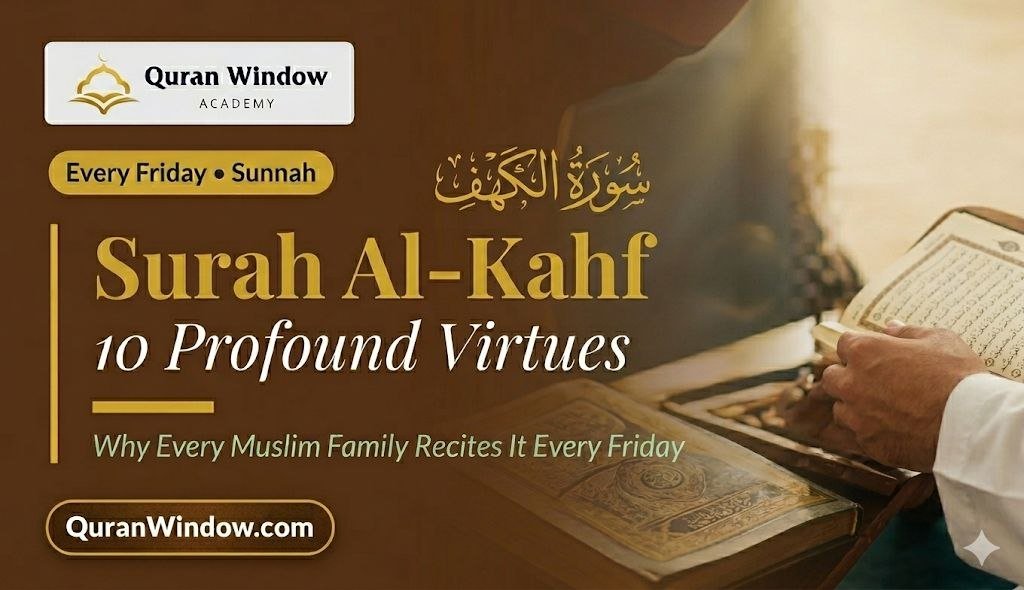
Of all the surahs of the Quran that are specifically recommended for recitation on particular days, none carries the weight, the evidence, and the enduring devotion of Surah Al-Kahf on Friday. Generation after generation of Muslim scholars, from the Companions to the present day, have upheld the weekly recitation of Surah Al-Kahf as one of the most important Sunnah practices a Muslim family can establish — a practice whose virtues are explicitly confirmed in authentic hadith and whose spiritual benefits have been witnessed by believers across fourteen centuries of Islamic history.
In this comprehensive guide, we explore the 10 most profound virtues of Surah Al-Kahf, the complete evidence for its Friday recitation, a detailed summary of its four magnificent stories, practical guidance for making Surah Al-Kahf a weekly family practice, and answers to the most commonly asked questions about this remarkable surah. By the end of this guide, the question will not be “should we recite Surah Al-Kahf every Friday?” — it will be “how do we begin tonight?”
What You Will Learn in This Complete Guide
✓ The 10 profound virtues of Surah Al-Kahf — with full hadith evidence
✓ Why Surah Al-Kahf is specifically recited on Friday — the complete Islamic reasoning
✓ The 4 powerful stories of Surah Kahf — summaries and lessons
✓ When to recite Surah Al-Kahf on Friday — the exact timing
✓ How to memorize Surah Al-Kahf — a step-by-step family plan
✓ How Islamic studies and Quran classes deepen understanding of Surah Al-Kahf
What Is Surah Al-Kahf? A Complete Introduction
Surah Al-Kahf (The Cave) is the 18th surah of the Quran, revealed in Makkah Al-Mukarramah. It contains 110 verses — making it one of the longer Makkan surahs — and occupies a central position in the 15th and 16th Juz of the Quran. The surah takes its name from the story of the young men (Ahl Al-Kahf) who took refuge in a cave and were kept in miraculous sleep by Allah for 309 years — one of the most extraordinary events described in the entire Quran.
Surah Al-Kahf is unique in the Quran in that it contains four complete, narrative stories — each with a distinct theme and lesson — woven together into a unified message about the nature of faith, the dangers of worldly temptation, the limitations of human knowledge, and the absolute sovereignty of Allah. These four stories make Surah Kahf one of the most narratively rich and thematically powerful surahs in the entire Quran — and one of the most rewarding to study and recite.
When Was Surah Al-Kahf Revealed?
Surah Al-Kahf was revealed in response to questions posed by the Quraysh of Makkah to the Prophet Muhammad ﷺ — questions about the People of the Cave, about a man who travelled the earth (Dhul-Qarnayn), and about the nature of the soul. These questions were designed by the Quraysh as a test of the Prophet’s ﷺ prophethood, based on advice from Jewish scholars in Madinah. The revelation of Surah Kahf was Allah’s complete, direct answer — affirming the Prophet’s ﷺ prophethood and providing the Muslim community with one of the most spiritually rich revelations of the entire Makkan period.
The 10 Profound Virtues of Surah Al-Kahf — Complete Hadith Evidence
The virtues of Surah Al-Kahf are among the most extensively documented in the Sunnah of the Prophet ﷺ. Here are the 10 most profound virtues — each with its authentic evidence:
Virtue 1: Light Between the Two Fridays
The most widely cited virtue of Surah Al-Kahf comes from the Prophet Muhammad ﷺ himself: “Whoever recites Surah Al-Kahf on Friday, light will shine for him between the two Fridays.” (Al-Hakim, authenticated; Al-Bayhaqi). This hadith establishes the core practice that has defined Islamic Friday tradition for over 1,400 years: the weekly recitation of Surah Kahf produces divine light that accompanies the believer for the entire week — from one Friday to the next.
This light is understood by scholars as a spiritual illumination — a clarity of heart, a guidance in decision-making, a protection from moral confusion and spiritual darkness — that the believer carries through their daily life until the following Friday’s recitation renews it. The virtue of Surah Kahf as a source of weekly spiritual light is, for many Muslims, the single most compelling reason to establish its recitation as a Friday practice.
Virtue 2: Light That Reaches from Earth to Heaven
Another authentic narration describes the reward of Surah Al-Kahf in even more expansive terms: “Whoever recites Surah Al-Kahf on the day of Friday, light will emanate for him that reaches from beneath his feet to the heavens above him.” (Al-Bayhaqi). The imagery here — light rising from the earth to the sky — describes a spiritual state that elevates the believer’s entire existence during the week that follows.
Virtue 3: Protection from the Dajjal
One of the most practically significant virtues of Surah Al-Kahf is its connection to protection from the Dajjal (the Antichrist) — the greatest trial that will ever be faced by the believers before the Day of Judgment. The Prophet ﷺ said: “Whoever memorizes ten verses from the beginning of Surah Al-Kahf will be protected from the Dajjal.” (Muslim). In another narration: “…from the end of Surah Al-Kahf.”
This virtue of Surah Al-Kahf has profound implications: the Dajjal will possess extraordinary abilities to deceive — extraordinary material gifts, claims to divinity, and the power to cause seemingly miraculous events. The protection provided by memorizing the opening or closing of Surah Kahf is therefore not merely a symbolic reward. It is described by the Prophet ﷺ as a genuine shield against the most powerful trial of fitnah (temptation) in human history.
The Prophet ﷺ said: ‘Whoever memorizes ten verses from the beginning of Surah Al-Kahf will be protected from the Dajjal.’ (Muslim) — This single virtue alone makes memorizing the opening of Surah Al-Kahf one of the most important acts of Quran memorization a Muslim can undertake.
Virtue 4: Forgiveness of Sins Between Two Fridays
Surah Al-Kahf is also described as a means of forgiveness. The Prophet ﷺ said: “Whoever reads Surah Al-Kahf on Friday, Allah will forgive him for the eight days that follow — until the next Friday.” (Al-Hakim). Combined with the light narration, this virtue presents the weekly recitation of Surah Al-Kahf as a complete weekly spiritual renewal: light to guide the week ahead and forgiveness for the week that has passed.
Virtue 5: The Surah of the Four Great Trials
Surah Al-Kahf is unique in the Quran in that it addresses the four fundamental trials (fitna) that the Prophet ﷺ identified as the most dangerous for believers across time: the trial of religion (Ahl Al-Kahf story), the trial of wealth (the Two Gardens story), the trial of knowledge (Musa and Al-Khidr story), and the trial of power (Dhul-Qarnayn story). The scholar Ibn Al-Qayyim described Surah Al-Kahf as the surah that provides complete guidance for navigating every major type of trial that faces the believer.
This breadth of guidance — addressing trials that every Muslim will face in some form — makes the regular recitation and study of Surah Kahf one of the most practically valuable Islamic practices a Muslim family can maintain.
Virtue 6: It Opens with Praise and Closes with Hope
Surah Al-Kahf begins: “All praise is for Allah who has sent down to His servant the Book and has not made therein any crookedness.” (18:1) — establishing at the outset that the Quran is a perfect, straight, uncorrupted guidance. It closes: “So whoever hopes for the meeting with his Lord, let him do righteous work and not associate in the worship of his Lord anyone.” (18:110) — ending with the ultimate Islamic aspiration: the hope for meeting with Allah, earned through sincere worship.
The opening and closing verses of Surah Al-Kahf together form a complete statement of Islamic faith — gratitude for revelation and hope in meeting the Revealer. The surah begins and ends at the highest level of Islamic consciousness, making its weekly recitation a complete spiritual immersion in the core of the faith.
Virtue 7: The Blessing of Yawm Al-Jumu’ah (Friday)
The connection between Surah Al-Kahf and Friday is itself a profound virtue — because Friday is the most blessed day of the Islamic week. The Prophet ﷺ said: “The best day upon which the sun rises is Friday. On it, Adam was created, on it he was entered into Paradise, and on it he was expelled from it.” (Muslim). Dedicating one’s Friday recitation to Surah Kahf is therefore an act of maximizing the blessing of the most blessed weekly occasion — honoring the day with a surah specifically designated for it by the Prophet ﷺ.
Virtue 8: A Source of Reflection and Wisdom for Families
The four stories of Surah Al-Kahf are among the most narratively powerful and morally instructive passages in the entire Quran — each containing lessons that are as relevant to the contemporary Muslim as they were to the Companions who first heard them. A family that recites Surah Al-Kahf every Friday and discusses one of its stories each week will, over the course of a month, have explored four of the most profound teachings in the entire Quran. This makes Surah Kahf not only a spiritual practice but a family education programm in Islamic wisdom.
Virtue 9: A Connection to the Greatest Islamic Scholars
The practice of reciting Surah Al-Kahf every Friday has been maintained by the greatest Muslim scholars throughout Islamic history — from the Companions, to the Tabi’een, to the scholars of every subsequent generation. When a Muslim family recites Surah Al-Kahf on Friday, they join an unbroken chain of devotion that connects them to the Companions of the Prophet ﷺ themselves. This spiritual continuity — the sense of participating in a practice that the best of generations maintained — is itself one of the most profound virtues of Surah Al-Kahf.
Virtue 10: The Most Accessible Major Weekly Sunnah
Finally, among the virtues of Surah Al-Kahf, one of the most practically significant is its accessibility. The surah is approximately 12 pages — readable in 20–30 minutes for a fluent reciter. Its four stories are memorable and engaging. Its Arabic is among the most narrative and accessible in the Quran. And its reward — a week’s worth of divine light and forgiveness — is available to every Muslim, every Friday, regardless of their level of Quran knowledge, regardless of their circumstances, and regardless of where in the world they are. Surah Al-Kahf is the most accessible major weekly Sunnah in the entire Islamic tradition.
The 4 Stories of Surah Al-Kahf — Summaries, Themes and Lessons
Understanding the 4 stories of Surah Al-Kahf transforms the weekly recitation from a phonetic exercise into a deeply meaningful engagement with some of the most powerful narratives in the Quran. Here is a concise summary of each:
Story 1: The People of the Cave (Ahl Al-Kahf) — Trial of Faith
📖 Surah Al-Kahf Verses 9–26
A group of young men, living in a society that demanded worship of false gods, refused to abandon their faith. They took refuge in a cave, trusting Allah with their lives. Allah caused them to sleep for 309 years — and when they woke, their faith was their only possession, intact and unchanged. The lesson: genuine faith survives every external trial when the believer’s trust in Allah is complete.
Story 2: The Two Gardens — Trial of Wealth
📖 Surah Al-Kahf Verses 32–44
A man who owned two magnificent gardens fell into the trap of arrogance — attributing his wealth to his own merit and denying the power of Allah. He was warned by a believing companion who reminded him that all wealth comes from Allah and can be taken away in an instant. The arrogant man’s gardens were destroyed. The lesson: wealth is a trust from Allah, not an entitlement — and arrogance before Allah is always destroyed.
Story 3: Musa and Al-Khidr — Trial of Knowledge
📖 Surah Al-Kahf Verses 60–82
Musa (AS), one of the greatest prophets of Allah, was sent to learn from a servant of Allah named Al-Khidr — who possessed knowledge that Musa had not been given. The journey taught Musa that human understanding is always limited, that the wisdom behind Allah’s decree is always perfect even when hidden from human sight, and that the greatest scholars are always students before their Lord. The lesson: knowledge is limited, but Allah’s wisdom is infinite.
Story 4: Dhul-Qarnayn — Trial of Power
📖 Surah Al-Kahf Verses 83–98
A powerful king given by Allah the ability to travel to the ends of the earth — east and west. Rather than using his power for oppression or pride, Dhul-Qarnayn used it to establish justice, help the weak, and build a barrier against the forces of Gog and Magog. When praised for his great deed, he attributed everything to Allah. The lesson: power is a trust from Allah — to be used for justice and humility, not pride and oppression.
📖 20 Essential Duas for Kids to Memorize — With Simple Arabic, Transliteration and Meaning
When to Recite Surah Al-Kahf on Friday — The Exact Timing
One of the most common questions Muslims ask about the virtues of Surah Al-Kahf is: “When exactly should I recite it on Friday?” The scholarly answer is generous and accessible:
From Thursday Night to Saturday Night
In the Islamic calendar, Yawm Al-Jumu’ah (Friday) begins at Maghrib on Thursday night and ends at Maghrib on Friday night. Therefore, the virtues of Surah Al-Kahf are available from Thursday evening through to Friday sunset — a generous window that accommodates every schedule and circumstance. The majority of scholars consider the entire Friday — from Thursday Maghrib to Friday Maghrib — as the valid time for the Jumu’ah recitation of Surah Al-Kahf.
The Best Time — Before or After Jumu’ah Prayer
While any time within the Friday window is valid, the most recommended times for reciting Surah Al-Kahf are:
- Before Fajr on Friday: Reciting after Isha on Thursday night or before Fajr on Friday — beginning the blessed day with the surah designated for it
- After Jumu’ah prayer: Immediately after the Friday prayer — combining the greatest weekly prayer with the greatest weekly Quran practice
- During the evening: After Asr on Friday — as the blessed day draws to a close
For families, the most sustainable practice is often after Jumu’ah prayer on Friday — when the family is already in a spiritual frame of mind and the children are aware of the significance of the day.
How to Memorize Surah Al-Kahf — A Step-by-Step Family Plan
The virtue of Surah Al-Kahf in protecting from the Dajjal — specifically tied to memorizing the first or last ten verses — makes Surah Al-Kahf memorization one of the most practically important Quran memorization goals a Muslim family can set. Here is the step-by-step family plan:
Phase 1: Perfect the Recitation First
Before any family member begins memorizing Surah Al-Kahf, their Quran recitation must be correct. Memorizing incorrect pronunciation embeds it permanently. At Quran Window Academy, every student’s recitation is verified by a certified Al-Azhar teacher before memorization begins — this is the non-negotiable foundation of the virtues of Surah Al-Kahf being available in their fullest form.
📖 Quran Recitation vs Memorization: 7 Powerful Differences Every Muslim Must Know
Phase 2: Begin with the First 10 Verses — Protection from the Dajjal
Start with the opening 10 verses of Surah Al-Kahf (verses 1–10). These contain the opening praise of Allah, the introduction of the surah’s central theme, and the foundation of the People of the Cave story. At 2–3 verses per day with daily revision, a dedicated student can memorize the opening 10 verses in approximately 4–5 days — achieving the protection-from-Dajjal virtue in under a week of focused effort.
Phase 3: Memorize the Full Surah Progressively
For those pursuing the complete memorization of Surah Al-Kahf, the 110 verses divide naturally into 4 story sections that can be memorized sequentially. With consistent daily sessions with a certified Hifz teacher — memorizing 5–7 verses per day with daily revision — most dedicated students complete Surah Al-Kahf in 3–4 weeks. A surah that takes a month to memorize and accompanies the believer for a lifetime is one of the best investments of time in Islamic life.
Deepen Your Understanding of Surah Al-Kahf at Quran Window Academy
The virtues of Surah Al-Kahf are fully accessed only by those who recite it correctly, understand its meaning, and have memorized its key passages. At Quran Window Academy, our certified Al-Azhar teachers offer the complete pathway — from correct recitation and Tajweed through to memorization and Arabic understanding — in one-on-one sessions with flexible scheduling.
🟢 RECITE CORRECTLY — Quran Recitation Course — Recite Surah Al-Kahf with Perfect Tajweed
✓ Certified Al-Azhar teacher verifies your Surah Al-Kahf recitation
✓ All Tajweed rules applied — Surah Al-Kahf contains the full range of Tajweed applications
✓ Correct Makharij for every letter — the foundation of correct recitation
✓ One-on-one sessions — every error corrected before it becomes a habit
✓ Free trial class — completely free, no commitment required
🔵 MEMORIZE FOR PROTECTION — Quran Memorization Course — Memorize Surah Al-Kahf
✓ Begin with the first 10 verses — the Dajjal protection Sunnah
✓ Structured daily memorization plan for the complete surah
✓ Certified Al-Azhar Hafiz teachers with proven Hifz methodology
✓ Daily revision programme to ensure every verse stays firm
🟡 UNDERSTAND THE MEANING — Arabic Language Course — Understand Surah Al-Kahf
✓ Quranic Arabic vocabulary from Surah Al-Kahf — its four stories use rich classical Arabic
✓ Understand the words of each story as you recite them
✓ Al-Azhar certified Arabic teacher in one-on-one sessions
🟠 STUDY THE STORIES — Islamic Studies Course — Tafsir of Surah Al-Kahf
✓ Complete tafsir of Surah Al-Kahf’s four stories — in depth
✓ The historical context of each story and its contemporary relevance
✓ How the four trials relate to every Muslim’s daily life
✓ Taught in English with Arabic references — accessible for all levels
🎓 Book Your Free Trial Class Now
One-on-one live lesson with a certified Al-Azhar teacher.
Your first lesson is completely free — no commitment, no payment.
Available for: Kids • Adults • Beginners • Sisters (Female Teachers)
Frequently Asked Questions: Surah Al-Kahf Virtues
FAQ 1: What are the virtues of Surah Al-Kahf?
The virtues of Surah Al-Kahf include: light between the two Fridays, protection from the Dajjal (for those who memorize the opening or closing 10 verses), forgiveness of sins for the week, divine light reaching from earth to heaven, and guidance through the four major trials of faith, wealth, knowledge, and power. All of these virtues are documented in authenticated hadiths.
FAQ 2: Why is Surah Al-Kahf recited on Friday specifically?
Surah Al-Kahf is recited on Friday because the Prophet Muhammad ﷺ specifically designated Friday as its day of recitation, promising a week’s worth of divine light to whoever recites it. Friday is the most blessed day of the Islamic week — and Surah Kahf is its designated Sunnah recitation, honoring the day with one of the most powerful surahs of the Quran.
FAQ 3: Can I recite Surah Al-Kahf on Thursday night?
Yes — since Friday in the Islamic calendar begins at Maghrib on Thursday evening, reciting Surah Al-Kahf after Thursday Maghrib prayer is within the valid time window and earns the complete virtues of Surah Al-Kahf for that Friday.
FAQ 4: Do I need to recite the complete Surah Al-Kahf or just part of it?
The complete recitation of Surah Al-Kahf earns the full virtue of light between the two Fridays. However, memorizing specifically the first 10 or last 10 verses earns the virtue of protection from the Dajjal — regardless of whether the complete surah is recited. Most scholars recommend reciting the complete surah when possible and beginning with the critical opening or closing 10 verses for the memorization practice.
FAQ 5: How long does it take to recite Surah Al-Kahf?
For a fluent Quran reciter, Surah Al-Kahf takes approximately 20–30 minutes to recite at a measured, Tajweed-correct pace. A family that recites it together after Jumu’ah prayer — each member reading a portion — can complete it in even less time while sharing the blessing across the household.
FAQ 6: What are the 4 stories of Surah Al-Kahf?
The four stories of Surah Al-Kahf are: (1) Ahl Al-Kahf — the people of the cave and the trial of faith, (2) the Two Gardens — the trial of wealth and arrogance, (3) Musa and Al-Khidr — the trial of knowledge and its limitations, and (4) Dhul-Qarnayn — the trial of power and its responsibilities. Each story is a complete moral and spiritual lesson.
FAQ 7: Is Surah Al-Kahf difficult to memorize?
Surah Al-Kahf is 110 verses — longer than most surahs that beginners memorize, but shorter than Surah Al-Baqarah or Surah Al-Imran. With a certified Hifz teacher and consistent daily practice, most dedicated students memorize the complete surah in 3–4 weeks. The narrative structure of the surah’s four stories makes its content memorable — each story follows a logical progression that supports memorization.
FAQ 8: Can children also benefit from the virtues of Surah Al-Kahf?
Absolutely — the virtues of Surah Al-Kahf are available to every Muslim who recites or memorizes it, regardless of age. Many Muslim families make the weekly Friday recitation of Surah Kahf a family activity — each child reciting whatever portion they have memorized, while parents recite the portions the children have not yet learned. This family practice creates a weekly Islamic ritual that children carry into adulthood.
📖 How to Build a Quran Routine for Your Family That Actually Sticks
FAQ 9: What does Surah Al-Kahf teach about the Dajjal?
Surah Al-Kahf teaches that the primary danger of the Dajjal is his ability to manipulate the four major human temptations — faith, wealth, knowledge, and power — each of which is addressed in one of the surah’s four stories. The protection offered by memorizing the opening 10 verses is specifically connected to the believer’s grounding in the correct understanding of these four areas, making them immune to the Dajjal’s deceptions in each domain.
FAQ 10: How do I get started reciting Surah Al-Kahf correctly?
The best first step is to verify your recitation with a certified teacher. Book a free trial class at Quran Window Academy, recite whatever portion of Surah Al-Kahf you know, and let your certified Al-Azhar teacher identify any errors and provide targeted correction. Once your recitation is verified, begin weekly Friday recitation and — when ready — work with your teacher on memorizing the opening 10 verses for the Dajjal protection virtue.
Make Surah Al-Kahf Your Family’s Friday Gift to Themselves
The virtues of Surah Al-Kahf are not reserved for scholars, for Huffaz, or for those with decades of Islamic study. They are available to every Muslim family that opens the Quran on Friday and recites — to every child who memorizes ten verses, to every adult who makes the 30-minute weekly commitment, to every household that makes Surah Kahf the heartbeat of their Friday.
Light between the two Fridays. Protection from the greatest trial in human history. Forgiveness for a week of human failing. Guidance through the four trials that every believer faces. A connection to 1,400 years of Muslim devotion. All of this — available every Friday, requiring only sincere recitation and a correct foundation that any qualified teacher can build in a handful of lessons.
At Quran Window Academy, your journey to correct, beautiful recitation of Surah Kahf begins with a single free lesson. Book it today — and let this Friday be the Friday that changes your family’s Fridays forever.
Whoever recites Surah Al-Kahf on Friday, light will shine for him between the two Fridays. — Prophet Muhammad ﷺ. Every Friday is an invitation. Every Surah Al-Kahf is a week of light. Begin tonight.
🎓 Book Your Free Trial Class Now
One-on-one live lesson with a certified Al-Azhar teacher.
Your first lesson is completely free — no commitment, no payment.
Available for: Kids • Adults • Beginners • Sisters (Female Teachers)